The Fastest Radio Modems

RipEX

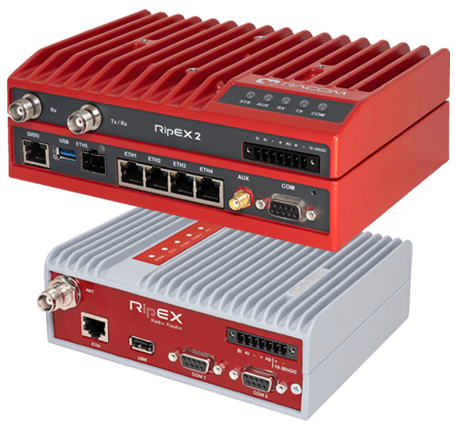
RipEX2, 2nd generation, was introduced in 2018. This more powerful radio and cellular modem in one provides significant improvements, especially in terms of data speed, security and number of interfaces. RipEX2e, the essential version, is suitable for less demanding installations.
RipEX, 1st generation, is a best-in-class compact radio modem. This native IP device with Linux has been designed with attention to detail, performance and quality. It is proven within the market since 2011 and used in thousands of installations.

https//www.racom.eu/eng/products/ripex-legacy-advanced-calculation

Calculations

Calculations 

RipEX settings

Operating Mode
Radio protocol
ACK
Channel spacing [kHz]
Mode
Modulation type
Modulation rate [kbps]
FEC


Use our calculations for a simplistic overview of RipEX network performance. RipEX settings are common for both independent parts – Payload bitrate and Netwok performance. Payload bitrate gives you a quick and easy idea of the possible bitrate in the RipEX network. Network performance is the more robust and detailed option. See the details in respective helps.

Payload bitrate 

Based on this calculation, one can see the effect packet length has on the resulting bitrate. Since the RipEX radio protocol overhead per packet is fixed, the longer the user data are, the higher the payload bitrate.

 Average message size bytes
User data size without any headers (IP, TCP, UDP, …).
 Payload bitrate kbps
The payload bitrate in kbps. Since RipEX uses customized IP packet on the Radio channel, payload bitrate includes 28 bytes of IP packet overhead – 20B IP header and 8B UDP header. This calculation assumes using the UDP as the Layer 4 protocol. If you are using TCP, the resulting bitrate would be lower due to higher TCP overhead – you can use our TCP proxy functionality to optimize the communication (see the Manual).
 One-hop forwarding time msec
The average time in milliseconds to transmit a single packet between two RipEX units.

Network performance 

Network performance calculation is intended to give you a quick performance overview based on several basic parameters.

 Total Number of sites
Number of RipEX units in the network. The minimum number of RipEX units is three (including the local unit). The calculations work with collision probabilities in the report-by-exception type of networks and are mainly intended for networks with many (> 5) units.
 Average hops per path to remote
Average hop count to the remote sites. E.g. 9 remote stations directly connected to the center (one radio hop) and one remote station over one repeater (two radio hops) results in 1.1.
Average message size 
User data size without any headers (IP, TCP, UDP, …).
center => remote bytes
remote => center bytes
Interface speed 
Ethernet interface speed or the baud rate [bps] for the serial (COM) interface. Using TCP instead of UDP lowers the total network capacity due to the higher TCP overhead (ETH – UDP/IP and serial options are equal.
center
remote
Processing time 
Time for the RTUs / SCADA devices to process queries.
center msec
remote msec

Polling Cycle (Single master)

 Average RTT per remote msec
Round Trip Time (RTT) is the time required for a packet to travel from the source (SCADA center) to the destination (remote RTU) and back again.
 Total polling cycle sec
The time required for the master (SCADA center) to poll all slaves (remote RTUs) one by one and to receive their responses.

Mesh mode 

In mesh type networks, all radio modems can access each other randomly and spontaneously. Mesh networks can also host polling or report-by-exception applications, even in several instances.
 Total IP network capacity bytes/sec
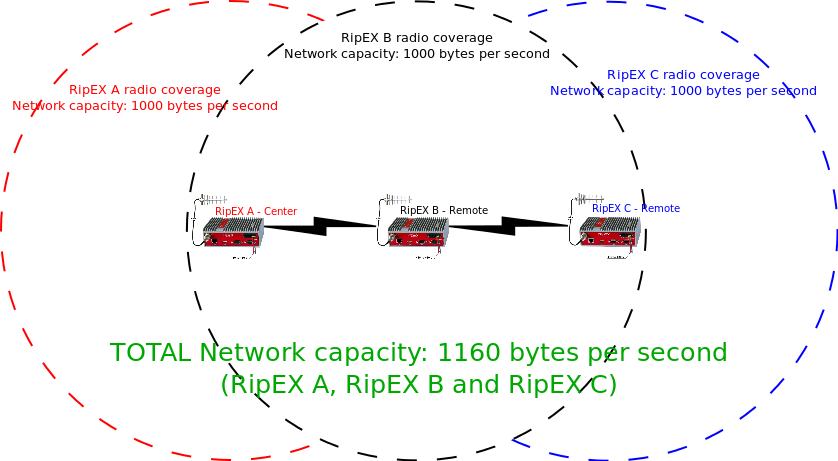
Total network capacity in bytes per second (includes IP packet overhead). The resulting number refers to the maximum number in the optimally designed RipEX network. The more hops per path, the less overlap, and consequently more capacity left for simultaneous transmissions from different remotes. That is the reason for a higher capacity with more hops in the network. Nevertheless, that figure can be fully used only when there is a significant portion of communication load among the remotes themselves, or from remotes to e.g. local concentrators. When all messages have eventually to reach the single master station over the same radio channel, any calculation of total network capacity loses its sense, for obvious reasons. Certainly such a "central radio bottleneck" can (and should) be eliminated by e.g. adding extra channels or wire connections to dominant repeaters or bypass dominant repeaters using more radio hops. Generally, every network employing narrowband radios requires "capacity-aware design".
Note: Total network capacity assumes that all radios in the network operate on the same RF channel.
 Total application network capacity bytes/sec
Total network capacity in bytes per second, but no IP packet overhead is included.
 Average message delivery time msec
Average time required for a message to be successfully delivered within the RipEX network in the report-by-exception mode (i.e. from the center to the remote unit).
Radio protocol Flexible only
Radio protocol Flexible only (Operating Mode = Router)
JavaScript must be enabled.

Questions?
Our Sales & Support team is ready!

©  2026 RACOM s.r.o. All Rights Reserved.