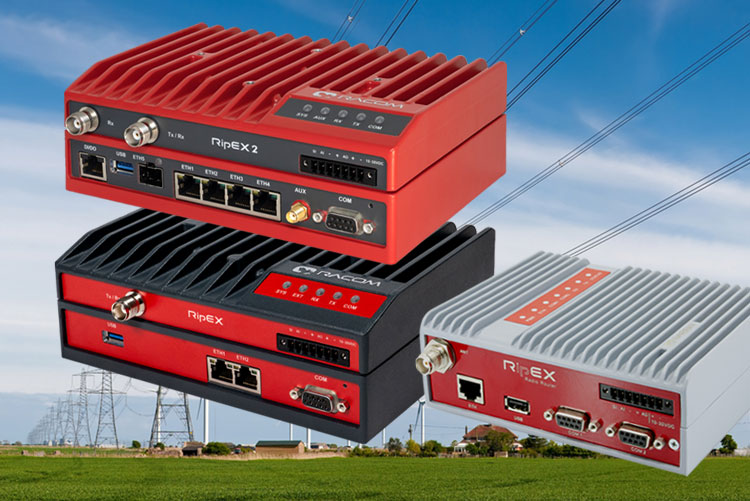
How do you upgrade a decade-old SCADA system in a hazardous gas-field environment – without downtime, without data collisions and while reusing the same radio frequency during migration? For Pakistan Petroleum Limited (PPL), the solution was RipEX and RipEX-HS.
Challenge: A Legacy SCADA Network Unable to Support New Field Compression Facility

Pakistan Petroleum Limited (PPL), a state-owned oil and gas company, operates the Adhi gas field south of Islamabad. To slow natural production decline, a new Field Compression facility was deployed. This increased the need for:

  • permanent, real-time wellhead monitoring
  • reliable communication from remote, hazardous locations
  • support for modern automation and reporting
  • low-power operation for solar sites
  • redundant master stations for maximum availability

PPL’s original SCADA system, installed about ten years earlier, no longer met the requirements of the upgraded production process.

System integrator Avanceon was contracted to design and build a modern, future-proof radio communication network.

Solution: RipEX and RipEX-HS Meet All Technical and Safety Requirements

After detailed analysis and consultation with PPL, the following requirements were identified as mandatory:

  • multiple serial and Ethernet ports
  • Base Driven Protocol (BDP)
  • high data speed in the 400 MHz band
  • low energy consumption for solar power systems
  • hazardous-area approval
  • fully redundant hot-standby master station

Only RACOM’s RipEX family met all criteria.

Key solution elements:

  • RipEX-HS redundant master station with automatic switchover eliminates downtime concerns
  • sleep / save mode ensures continuous 24/7 operation on solar power
  • built-in Modbus TCP server and Modbus TCP–RTU conversion simplify SCADA integration
  • RACOM’s Migration mode allows coexistence with the old network on the same frequency, ensuring a seamless cutover without collisions
  • gradual migration of RTUs and radios without any service disruption

Results: Faster, More Reliable and Easier to Maintain

Since commissioning, PPL and Avanceon have monitored the new network closely. They report:

  • significantly higher reliability than the legacy system
  • much faster communication performance
  • easier configuration and maintenance
  • improved operational awareness and reduced manpower needs

The success of the project led to approved planning and budgeting for expansion to additional sites.

Avanceon praised the level of support provided by RACOM and expressed eagerness to collaborate on future deployments across Pakistan’s critical oil and gas infrastructure.

How do you build a highly reliable communication network for a national-scale utility when fibre optics cannot reach most substations due to terrain? For EDCO in Jordan, the answer was a fully redundant UHF network built on RipEX and RipEX-HS.

Challenge: Extreme Reliability Requirements for a Nationwide SCADA/DMS/AMR System

The Electricity Distribution Company (EDCO), established in 1997, is responsible for electricity distribution planning, installation, operation and maintenance across more than half of Jordan.

In 2015, EDCO launched a tender for a major project: to connect selected substations to a new SCADA / DMS / AMR control centre in Amman. The system needed to:

  • monitor and control both existing and future distribution networks
  • ensure continuous visibility and management across all EDCO regions
  • meet the highest reliability and redundancy standards
  • comply with IEC 60870-5-104 requirements
  • support long-term expansion and evolving operational needs

While EDCO initially hoped to use fibre optics, extensive field analysis revealed that physical constraints made fibre feasible only in a very limited part of the territory.

Solution: RipEX and RipEX-HS Redundant Architecture in 400 MHz UHF

After extensive research and testing, EDCO concluded that a UHF data radio network could provide the required availability – but only when using best-in-class equipment.

RipEX and its 1+1 hot-standby version RipEX-HS were selected due to:

  • full redundancy with automatic switchover
  • extremely high reliability and availability
  • dual AC/DC power supplies in every HS unit
  • support for IEC 104 using Base Driven protocol
  • advanced routing functionality
  • RF output power up to 10 W where required
  • proven long-term robustness in harsh environments

Deployment: Custom-Built RACOM Cabinets and Turnkey Integration

The initial deployment includes:

  • 12 RipEX-HS redundant stations
  • 25 RipEX radio modems
  • Siemens Ruggedcom switches
  • ABB RTUs

All equipment is delivered inside custom indoor wall-mount cabinets, designed, wired and tested by RACOM to EDCO’s exact specifications. This ensured:

  • fast installation
  • complete uniformity across sites
  • minimal work required on-site
  • simplified project logistics for the contractor

RACOM provided extensive support:

  • remote technical assistance
  • detailed design consultations
  • on-site commissioning visits
  • ongoing troubleshooting and optimization

This support was crucial to keeping the multi-stage project on schedule.

Results: A Reliable, Expandable Backbone for National Power Distribution

EDCO and its contractor reported high satisfaction with:

  • product quality
  • network reliability
  • responsiveness and professionalism of RACOM support
  • the turnkey nature of RACOM’s cabinet solution

The RipEX-based UHF network now provides:

  • mission-critical SCADA connectivity
  • reliable operation in challenging geographies
  • redundancy across all primary sites
  • a clear path for future network expansion

Based on the project’s success, EDCO is already discussing additional phases to further extend the RACOM-powered communication network across Jordan.

How do you deliver high-speed connectivity across some of the windiest, wettest and most remote islands in Europe – where salt, storms and corrosion destroy most microwave links within months? For CloudNet in Scotland, the answer is RAy3.

Challenge: Extreme Weather, Harsh Topography and High Interference

CloudNet IT-Solutions Ltd is a systems integrator and wireless ISP specialising in hard-to-reach rural areas. Their networks support:

  • residential broadband as part of the UK Government’s National Broadband strategy
  • corporate and private customers
  • onshore windfarms requiring connectivity to Scottish and Southern Energy (SSE)
  • advanced research, including the “5G Rural First” project

But the Northern and Western Isles of Scotland present severe challenges:

  • relentless North Atlantic storms
  • heavy salt exposure causing rapid corrosion
  • difficult terrain with long water crossings
  • high levels of interference
  • legacy microwave links lasting less than three months before failure

CloudNet needed a solution that could survive harsh environmental conditions while delivering stable, long-distance connectivity.

Solution: RAy3 Provides Industrial-Grade Reliability and Interference Resistance

When CloudNet trialled RACOM RAy3, the results were transformative.

Key advantages:

  • industrial-hardened construction designed for extreme weather
  • heavy-duty components resistant to salt and corrosion
  • exceptional immunity to noise and interference
  • long-distance stability across open water
  • high-capacity links up to 1 Gbps

After minor initial parameter tuning, RAy3 links required no hardware maintenance.

The first installation – deployed in spring 2018 – is still in service today, running flawlessly despite years of Atlantic storms.

Results: A Maintenance-Free Network That Powers Rural Connectivity

CloudNet now uses RAy3 extensively across the Northern and Western Isles for:

  • backhaul
  • last-mile access
  • island-to-island interconnections
  • renewable energy infrastructure
  • advanced 5G trials

Operational benefits:

  • zero corrosion-related failures
  • stable performance in harsh marine environments
  • reliable connectivity that upholds CloudNet’s reputation for availability
  • reduced maintenance costs and fewer field interventions

RAy3 has become a permanent part of CloudNet’s infrastructure – a proven, maintenance-free microwave solution built for some of the toughest conditions in Europe.

How do you build a high-capacity fixed wireless network across rural and urban Ireland – one that serves thousands of customers and grows year after year? For Ripplecom, the answer was RAy.

Challenge: A Growing Service Provider Needing Robust, Easy-to-Deploy Backhaul

Ripplecom, based in Limerick, operates Ireland’s largest fixed wireless network. By 2017, it was providing:

  • connectivity to 2,000 business clients
  • broadband to 4,000 private households
  • voice, data backup and IT security services

To expand rapidly and reliably, Ripplecom needed a microwave platform that could:

  • provide high-capacity backhaul for Fixed Wireless Access (FWA)
  • deliver synchronous dedicated bandwidth to corporate customers
  • support long-term scalability
  • operate reliably in Ireland’s unpredictable weather
  • deploy quickly and easily across the country

Solution: RAy Microwave Links at 17, 18 and 24 GHz

Ripplecom incorporated RAy microwave links into its network beginning in 2015.

By late 2017, approximately 100 RAy links were in service.

RAy was selected for:

  • exceptional system gain
  • high resistance to disturbances
  • robust performance in windy, coastal and rainy environments
  • top-tier link budget and modulation options
  • extremely easy installation and configuration

Primary use cases:

  • Backhaul of FWA sectors to support enterprise-grade services
  • Last-mile links in locations requiring high-speed dedicated connectivity

Results: Faster Rollouts, Higher Reliability and Better Customer Service

Ripplecom’s engineers emphasised that RAy is not only technically excellent – it is also designed for real-world deployment:

“RAy was clearly designed with engineers in mind which makes it much easier and faster to roll out.”

With RAy, Ripplecom achieved:

  • quick deployment of new microwave links
  • stable, interference-resistant connectivity
  • reliable high-speed backhaul
  • improved quality of service for corporate and residential customers
  • a scalable infrastructure supporting continuous business growth

RAy now plays a key role in Ripplecom’s nationwide wireless network, helping deliver dependable connectivity to thousands across Ireland.

How do you build reliable backhaul links in a tropical climate where heavy equatorial rains routinely disrupt radio communication? For several major organisations in Ghana, the answer is RAy microwave links.

Challenge: Frequent Outages and Unstable Connectivity in Harsh Equatorial Weather

Arrow Network Systems in Ghana provides wireless communication solutions to government institutions and blue-chip organisations. Their customers include:

  • the Ghana Ports and Harbours Authority, a key player in West African trade and logistics
  • Ghana Community Network Services (GCNet), a major public-private provider of e-Government services

Both organisations struggled with:

  • unstable existing communication links
  • severe signal degradation during heavy equatorial rainfall
  • inadequate throughput to support growing digital services
  • inconsistent reliability across extended distances

A new backhaul infrastructure was required – one capable of delivering consistent throughput and link stability despite tropical weather patterns.

Solution: RAy Microwave Links Provide High-Capacity, Long-Distance Backhaul

After evaluating all available communication technologies, microwave backhaul was selected as the best option due to:

  • lower deployment cost
  • faster installation
  • ability to deliver the required bandwidth
  • strong performance over long distances

Detailed link design identified RACOM RAy as the optimal platform.

Key reasons for selecting RAy:

  • stable data speeds of 100 Mbps and above
  • availability exceeding 99%
  • modern IP features including VLANs
  • high resistance to rain fade and equatorial humidity
  • flexible configurations using 10 GHz, 11 GHz and 17 GHz bands
  • support for long links up to 24 km

Deployment: High-Stability Links Tailored to Varying Distances

Typical deployed antennas:

  • 90 cm
  • 68 cm
  • 40 cm

Link designs were adapted based on distance and environmental conditions.

The longest link – 24 km using RAy-11 units – delivered stable throughput despite challenging rainfall patterns.

Results: Reliable Connectivity for Government and Critical Services

The RAy backhaul network now provides:

  • stable high-capacity links that do not drop during heavy rain
  • secure, reliable communications for government and port authorities
  • improved performance of national e-Government systems
  • long-term operational stability
  • a scalable foundation for future expansion

Customer satisfaction has been extremely high, and additional RAy links are already planned as the network continues to grow across Ghana.

How do you guarantee mission-critical communication between an air traffic control centre and a remote communications tower across 18 km of hot desert terrain – where temperatures exceed 50 °C and no other technology can maintain stability? For the UAE’s Civil Aviation Authority, the answer was RAy.

Challenge: Long-Distance ATC Communication Across Harsh Desert Conditions

The General Civil Aviation Authority (GCAA) is responsible for:

  • regulation and supervision of civil aviation across the UAE
  • en-route navigation services
  • flight safety
  • coordination of communication infrastructure for airports and towers

At Fujairah Airport, communication between the air traffic control centre, and the critical communications tower was unstable and unreliable. The tower hosts:

  • voice communication systems for aircraft
  • navigation systems
  • other essential ATC services

Reliable connectivity was essential, but two major problems made this difficult:

  • a long 18 km distance
  • hilly terrain between the sites
  • extreme desert temperatures above 50 °C

Several solutions were tested, but none could provide the reliability required for ATC operations.

Solution: RAy 11 GHz Microwave Link with High-Gain 90 cm Antennas

After a full transmission analysis performed by RACOM, the proposed solution was:

  • RAy microwave units
  • operating in the 11 GHz band
  • using 90 cm antennas to maximise link margin

Why RAy was selected:

  • outstanding receiver robustness and sensitivity
  • high throughput even in challenging propagation conditions
  • resistance to interference
  • every unit is climate-chamber tested for desert temperatures
  • reliable performance on long-distance links

GCAA approved the proposal and installed the RAy link. A RACOM engineer was prepared to assist onsite, but the installation went so smoothly that support was not required.

Results: Zero Downtime Since 2015

Since the link went operational in 2015, it has delivered:

  • 0 minutes of downtime
  • stable –65 dBm RSSI
  • flawless voice and data communication
  • reliable support for ATC and carrier operations
  • significant improvement in operational confidence

GCAA reports high satisfaction with the quality, stability and resilience of the link, which has become a crucial component of the region’s air navigation infrastructure.

RAy continues to ensure safe, uninterrupted communication in one of the world’s hottest and most demanding operational environments.

How do you ensure nationwide emergency communication resilience in an island nation where hurricanes, storms and fibre outages pose constant risks? For the Government of Jamaica, the answer was a robust microwave backbone built on RAy.

Challenge: A Reliable Backbone for a National Disaster and Emergency Network

The Jamaican government set out to build a National Disaster–Emergency Two-Way Mobile Communication System to support:

  • emergency coordination
  • communication between national and municipal government centres
  • high-speed transfer of voice, data and images
  • backup connectivity in case of fibre failure

After reviewing multiple technologies, the government concluded that microwave links offered the best performance, resilience and deployment speed for Jamaica’s mountainous and coastal terrain.

Solution: RAy 11 GHz Microwave Links Selected After Extensive Testing

Following thorough testing and evaluation, RAy was chosen as the optimal solution due to:

  • high throughput and bandwidth
  • excellent reliability
  • robust performance during adverse island weather
  • competitive pricing
  • fast and simple installation
  • strong long-term stability

During final network design, the solution was expanded to maximise its value and support additional government services:

  • links provide broadband connectivity between central government and municipal councils
  • at selected municipal sites, the RAy backbone serves as last-mile connectivity for voice, data and image transmission
  • the network also supports traffic light systems, camera systems, and redundant high-speed communication
  • designed to support future public-safety and smart-city applications

Deployment: Connecting 25 Radio Repeater Sites and 14 Government Centres

The nationwide backbone interconnects:

  • over 25 two-way radio repeater sites
  • 14 local government centres

The system functions both as a primary microwave backbone and as a fibre-backup layer, ensuring high availability even during storms.

According to Antonio Peterkin, RACOM’s distributor in Jamaica:

“There were no installation problems and everything operates exceptionally well with no downtime experienced.”

Results: A Modern, Resilient National Communication Infrastructure

The RAy microwave network provides Jamaica with:

  • stable nationwide connectivity for emergency communication
  • high-speed two-way communication for disaster response
  • redundancy for critical fibre-optic links
  • reliable connectivity despite harsh weather events
  • flexible infrastructure supporting multiple government applications

RAy now forms a critical component of Jamaica’s national emergency-response capability, delivering the reliability and stability required to safeguard citizens and infrastructure.

How do you connect the most critical substations of a utility serving nearly 10 million people – with guaranteed availability, long-term stability and capacity high enough to replace legacy microwave systems? In Rio de Janeiro, the answer is full-duplex RipEX2.

Challenge: High-Capacity, High-Reliability Connectivity for Critical Substations

RACOM has operated in Brazil for many years, with hundreds of RipEX installations across the country. In 2022, together with our long-term partner Utili, we were approached by one of Brazil’s largest distribution companies.

Their requirements were clear:

  • high-throughput links between major substations
  • operation in the licensed 400 MHz band
  • full-duplex point-to-point communication
  • maximum availability for SCADA traffic
  • long-term replacement for Aprisa XE links, which no longer met reliability needs

For the most important substations, data volumes were so high that shared radio channels or p-t-mp topologies were not sufficient. Dedicated full-duplex links were required.

Solution: RipEX2 Full-Duplex Links Deliver 1.6 Mbps and Carrier-Grade Availability

In phase one, three full-duplex RipEX2 links were deployed using the RipEX2-RS 19” rack chassis together with external duplexers.

Performance highlights:

  • 256 QAM modulation in 250 kHz channels achieving 1.6 Mbps symmetrical throughput
  • link distances of 9 and 10 km, both achieving 99.9% long-term availability
  • robust 16DEQAM used on a complex 9 km path with heavy multipath reflections, reaching 1.1 Mbps at 98% availability

All links operate in the licensed 400 MHz band, providing excellent coverage and stable propagation in Rio de Janeiro’s challenging geography.

Installation, optimisation and commissioning were carried out with the support of RACOM engineer Lorena, based in Brazil and responsible for technical support across Latin America.

Results: Outstanding Performance and a Strong Foundation for Expansion

The customer was impressed by:

  • the high throughput achieved over 400 MHz
  • the stability and availability of full-duplex RipEX2 links
  • the improved reliability compared to the previous Aprisa XE solution
  • the flexibility of 19” rack installation using RipEX2-RS

Encouraged by the results of the first three links, the utility plans to expand its RipEX2 full-duplex network across additional substations in the near future.

RipEX2 has now proven itself as a superior, modern and highly reliable communication platform for Brazil’s critical power infrastructure.

How do you replace an aging RDS-based radio network across 1,900 km of water and sewer infrastructure – without service outages and while preparing for fully IP-based SCADA? For Vodovody a kanalizace Hradec Králové, a.s. (VAK HK), the answer was a hybrid network built on RipEX and M!DGE.

Challenge: Aging Legacy Radios and the Need for a Future-Proof SCADA Network

VAK HK provides drinking water and wastewater services to more than 170,000 residents, operating:

  • over 1,350 km of water mains
  • 550 km of sewer infrastructure
  • dozens of pumping stations, reservoirs and treatment facilities

The existing SCADA communication system relied on CONEL CDA radios using serial RDS protocol. With end-of-life support for CONEL devices, VAK HK needed:

  • a modern, reliable IP-ready network
  • seamless migration with no outages
  • long-term cybersecurity and SCADA flexibility
  • a design that supports fully redundant data centres

A hybrid network combining radio and LTE was identified as the optimal approach.

Solution: RipEX and M!DGE Form a Unified Hybrid Architecture

After evaluating several vendors, VAK HK determined that RACOM was the only supplier able to meet all requirements.

Key reasons:

  • RipEX and M!DGE share software logic and management principles
  • routing managed centrally by one RipEX, simplifying application interfaces
  • seamless hybrid operation with RipEX providing RF access and M!DGE providing LTE backup
  • highly reliable Flexible protocol for long radio paths
  • RACOM’s Migration Solution enabling parallel legacy and new-network operation
  • RACOM-manufactured cabinets providing a complete turnkey deployment

Migration Strategy: Zero Downtime and Full Parallel Operation

Migration used two frequencies:

  • one for the legacy CONEL network
  • one for the new RipEX network

Key repeater sites were equipped with duplexers, enabling both frequencies to operate simultaneously. This allowed a phased migration during normal maintenance windows.

High-Availability Hybrid Operation
27 primary sites, classified as critical, were equipped with both RipEX and M!DGE.

Workflow:

  1. Legacy RTUs connect to RipEX via serial or IP.
  2. RipEX handles all routing and path selection.
  3. If LTE is available, RipEX backup routing automatically diverts traffic through M!DGE.
  4. The M!DGE segment uses GRE tunneling over a private APN, terminated on a Cisco ASR at the customer’s data centre.

Result: near-100% availability across all primary sites.
69 secondary sites were migrated to RipEX only, using RDS serial or Modbus TCP.
All equipment was delivered in RACOM-built outdoor/indoor cabinets for consistent installation quality.

Results: A Modern, Resilient and Scalable Water Utility Network

The hybrid RipEX + M!DGE solution delivered:

  • seamless migration without outages
  • dramatically higher availability through LTE backup
  • unified routing logic and simplified SCADA integration
  • readiness for TCP/IP and future report-by-exception
  • long-term reliability for both primary and secondary sites

Phase two is already planned and will include:

  • two geographically separate, fully redundant data centres
  • a private MPLS network interconnecting data centres and relay points

The hybrid RACOM solution now forms the communication backbone of one of Czechia’s largest water utilities – modern, resilient and ready for the next decade of SCADA evolution.

How do you build a reliable communication network in the Italian Alps – across 7,500 km², with temperatures below –30 °C, solar-powered stations and altitudes up to 3,400 m? You choose RACOM MORSE.

Challenge: A Unified High-Altitude Network for Civil Protection

The Department of Civil Protection of the Bolzano region needed to replace and unify several aging, incompatible networks used for:

  • Avalanche monitoring
  • Hydrometric measurements
  • Meteorological data collection

The goal was a single, robust system capable of operating:

  • At extreme altitudes up to 3400 m (Mount Wilder Freiger – one of Europe’s highest stations)
  • In temperatures often dropping below –30 °C
  • With solar power and sleep mode operation
  • Across 7,500 km² of rugged alpine terrain
  • With the ability to integrate all existing station equipment

The previous systems – HYDRO98, CAE radio, landlines, GSM dial-up and GPRS – each had limitations in cost, stability or disaster-resilience.

Solution: MORSE with MR400 – Reliable Communication at 400 MHz

The MORSE system using MR400 radio modems was selected as the only platform able to fulfil all operational and environmental requirements.

System highlights:

  • 400 MHz simplex operation ideal for mountainous terrain
  • 17 backbone stations and 70 terminal stations
  • Fully redundant backbone, with two MR400 radios at each hub
  • Wide interface support: Ethernet, up to 4× RS232, 2× RS422/485, GPS, M-BUS, I/O
  • Integrated remote diagnostics
  • Sleep mode for solar-powered sites
  • High sensitivity enabling long-range coverage

The solution merged all five legacy systems into one dependable, efficient network.

Results: Continuous Monitoring in One of Europe’s Harshest Environments

With more than 100 units deployed, the network now provides:

  • Real-time avalanche data
  • Meteorological information from ultra-high-altitude stations
  • Hydrometric readings for water management
  • Reliable long-range communication even in deep winter

MORSE has enabled a resilient monitoring system that supports public safety, environmental protection and rapid response across the Italian Alps.

©  2026 RACOM s.r.o. All Rights Reserved.